How to Gracefully Shed Roles That No Longer Serve Your Future Self
How to gracefully let go of outdated roles after 50. Discover how women can embrace midlife with confidence, healthy boundaries, and intentional living.
PERSONAL GROWTHCONFIDENCE & BOUNDARIES FOR WOMEN OVER 50
Vilmarie Barens
7/8/20265 min read
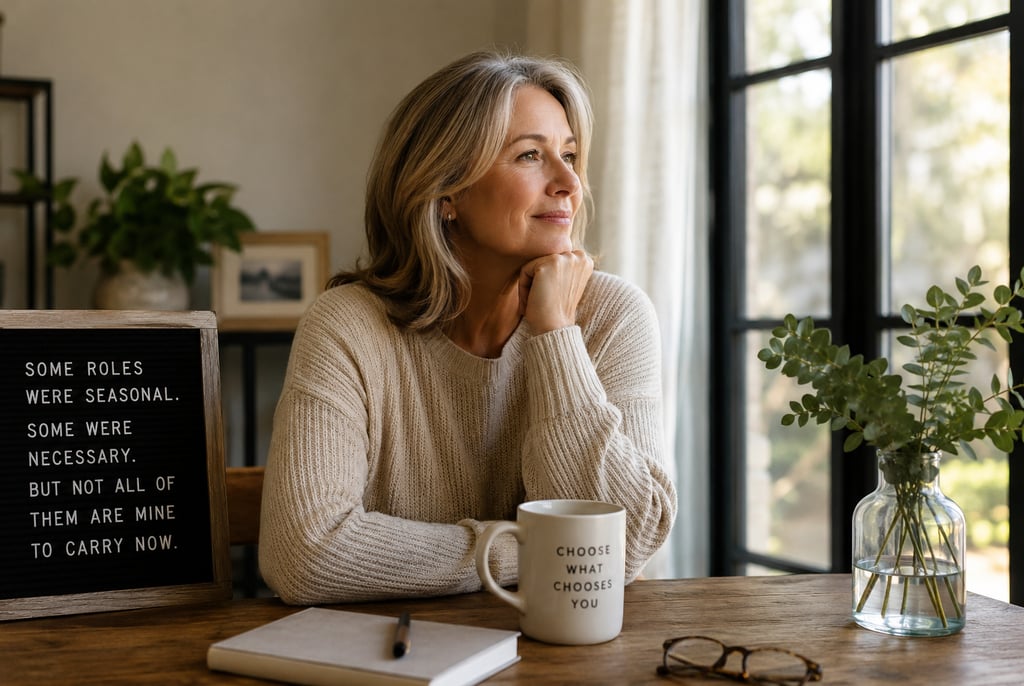

Growth doesn't always require becoming someone new. Sometimes it asks us to gently release who we've outgrown.
The other morning, before I'd even finished my first cup of coffee, I had already answered a handful of questions.
One person needed advice.
Another wanted reassurance.
Someone else assumed I would know exactly what to do.
None of it felt unusual. In fact, it felt so familiar that I almost didn't notice it.
Almost.
As I sat there, I realized how naturally I had stepped into the role of problem-solver. Not because anyone had forced me into it, but because I'd been that person for so many years that it had become part of my identity.
And it made me wonder.
How many of the roles I still carry actually belong to the life I'm living today?
It's a question I never would have asked twenty years ago.
Back then, life was about becoming.
Becoming more capable.
More accomplished.
More dependable.
More available.
There was always another responsibility waiting, another person who needed me, another goal to reach. Every new season seemed to ask me to add something else to the woman I already was.
But somewhere along the way, the question quietly changed.
Instead of asking, What else can I become?
I found myself asking,
What have I outgrown?
For me, that has been one of the unexpected gifts of midlife.
People often describe this season as a crisis.
I don't see it that way anymore.
I think it's an awakening.
It's the first time many of us pause long enough to notice just how many identities we've collected over the years.
Daughter.
Wife.
Mother.
Professional.
Caregiver.
Organizer.
Mediator.
The dependable one.
The strong one.
The one who always says yes.
The one everyone calls first.
At one time, every one of those roles served a purpose.
They helped me build a family.
Build a career.
Build relationships.
Build a life.
I'm grateful for them.
But gratitude doesn't mean every role deserves a permanent place in my future.
That realization has been surprisingly freeing.
For years, I believed growth meant adding more.
More knowledge.
More productivity.
More goals.
More accomplishments.
Now I think growth often looks much quieter.
Less like climbing.
More like editing.
It's sitting with yourself long enough to ask honest questions.
Does this still fit?
Does this still reflect who I am?
Does this still deserve my energy?
Those questions can be uncomfortable.
Especially for women.
Many of us were raised to believe our worth was closely tied to how much we could carry.
We became experts at anticipating needs before anyone spoke them aloud.
We remembered birthdays.
Solved conflicts.
Managed households.
Supported careers.
Raised children.
Checked on aging parents.
Kept traditions alive.
Held emotional space for everyone else.
Somewhere in all of that, many of us quietly learned that being needed felt safer than simply being ourselves.
No wonder letting go feels unfamiliar.
One of the hardest roles I've had to loosen my grip on is the role of the fixer.
There is something deeply satisfying about being capable.
About being the one who can step in and make everything okay.
For a long time, I thought helping people was simply what loving people looked like.
Sometimes it is.
But I've also learned that constantly rescuing others can slowly become a burden we never intended to carry.
Sometimes helping becomes controlling.
Sometimes support becomes interference.
Sometimes love quietly turns into over-responsibility.
That realization wasn't easy.
Especially as a mother.
Even after children become adults, many of us continue managing from a distance.
We remind.
We worry.
We anticipate.
We step in before we're asked.
We convince ourselves we're simply being supportive.
Sometimes we are.
Sometimes we're still living inside a role that no longer fits the season we're in.
Learning the difference takes courage.
So does stepping back.
Because growth rarely asks us to hold on tighter.
More often, it asks us to loosen our grip.
The people-pleaser in me has had to learn this lesson too.
For years, kindness and availability felt like the same thing.
If someone asked, I said yes.
If someone was disappointed, I felt responsible.
If conflict appeared, I rushed to smooth it over.
Eventually I realized something that changed everything.
Kindness and self-abandonment are not the same thing.
Generosity and depletion are not the same thing.
Compassion and obligation are not the same thing.
The older I get, the more those distinctions matter.
Not because I've become less caring.
Because I've become more intentional.
I no longer believe every request deserves a yes.
I no longer believe disappointing someone automatically means I've done something wrong.
And I no longer believe my value is measured by how much I can carry.
That shift hasn't made me harder.
It's made me healthier.
One thing I've learned is that permission rarely comes from other people.
No one wakes up one morning and tells us we're finally allowed to stop over-functioning.
No one hands us a certificate saying we've earned the right to rest.
Permission usually arrives much more quietly.
It's the first time we don't answer a text immediately.
The first weekend we protect instead of giving away.
The first boundary we set without writing a three-paragraph explanation.
The first "no" that doesn't leave us apologizing for days afterward.
Little by little, we begin realizing something remarkable.
The world keeps turning.
Life doesn't fall apart.
And neither do we.
Of course, not everyone welcomes our growth.
Some people become attached to the version of us that made their lives easier.
The woman who never asked for help.
The woman who always said yes.
The woman who quietly carried everyone else's emotional weight.
When she begins changing, people notice.
Sometimes they resist.
That's uncomfortable.
But it's also normal.
Our future isn't responsible for protecting someone else's comfort.
It's responsible for honoring the woman we're becoming.
Lately I've realized that much of what I've been carrying wasn't meant to be carried forever.
Some responsibilities belonged to another chapter.
Some expectations were inherited.
Some obligations were self-imposed.
Some identities quietly expired years ago, and I simply forgot to put them down.
Nature understands this better than we do.
Trees don't apologize for shedding their leaves.
They don't cling to what has already served its purpose.
They trust the next season.
Maybe we're invited to do the same.
Not dramatically.
Not with resentment.
Not by pretending those earlier versions of ourselves never existed.
But with gratitude.
The woman I was twenty years ago deserves my appreciation.
She carried me through seasons I couldn't have imagined.
She worked hard.
She loved deeply.
She held everything together when she had to.
She did exactly what that season required.
But she doesn't have to keep carrying today's life.
I can thank her.
I can honor her.
And then, with enormous gratitude, I can let her rest.
Because this season isn't asking me to become someone entirely new.
It's asking me to gently release the roles I've outgrown.
To make room for quieter priorities.
Health.
Peace.
Presence.
Authenticity.
Joy.
And perhaps that's what growth really is.
Not endlessly becoming more.
But courageously carrying less.
Less obligation.
Less proving.
Less guilt.
Less pretending.
So that what's left is finally, unmistakably, me.
If this stirred something in you, I’d love for you to follow the journey on Substack.
Subscribe there for more reflections like this, and feel free to share this with someone who may need it too.