When Your Daughter Becomes a Mother Too
How motherhood changes shape—but never really ends
MIDLFE REFLECTIONS
Vilmarie Barens
5/8/20264 min read
There’s a moment that happens quietly for many women in midlife.
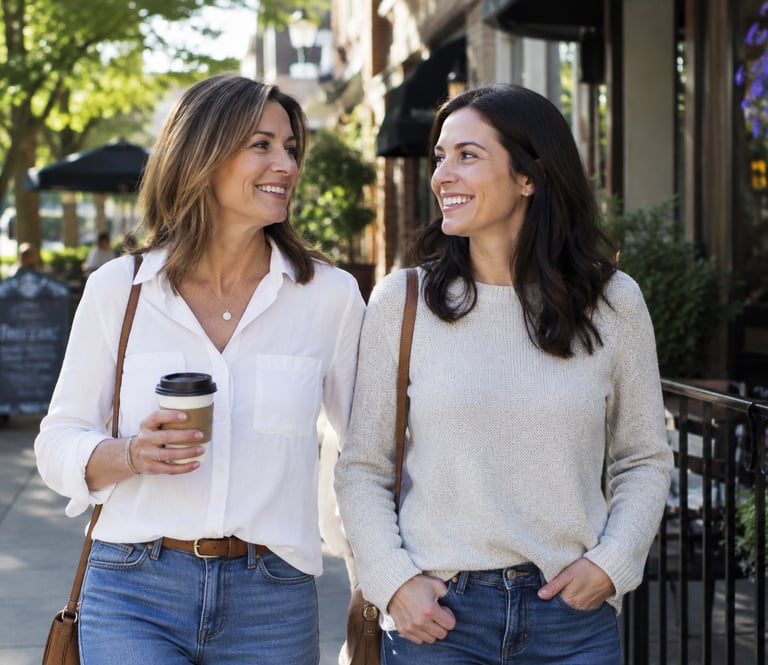
One day, you look at your daughter—not as the little girl who once needed you for everything—but as a woman building a life of her own. Maybe she’s raising children now. Maybe she’s balancing work, exhaustion, relationships, and responsibility in ways that suddenly feel familiar to you. And somewhere in that shift, something tender happens between you.
You stop standing only in front of her as “Mom.”
You begin standing beside her as a woman who understands.
I think that’s one of the most beautiful parts of motherhood that nobody fully prepares you for. The relationship doesn’t end as our children grow. It deepens. It changes shape. It softens in some places and strengthens in others. And even when our daughters become mothers themselves, we never really stop mothering.
We just mother differently.
When we’re younger mothers, motherhood often feels physical. It’s schedules and school lunches and permission slips and laundry and sleepless nights. It’s carrying everyone emotionally while trying not to drop ourselves in the process.
But midlife motherhood feels quieter.
It becomes checking in without hovering. Listening more than advising. Respecting boundaries while still wanting to protect. It becomes understanding that your daughter now carries invisible mental loads of her own—the kind she probably never noticed you were carrying all those years.
And maybe, for the first time, she sees you differently too.
Not just as “Mom.”
But as a woman.
A woman who was figuring things out while raising children.
A woman who was tired sometimes.
A woman who didn’t always have the answers but kept showing up anyway.
I think daughters begin to understand their mothers in a completely new way once life starts asking more of them.
There’s compassion that grows there.
Grace too.
At least that’s been my experience.
The conversations change in midlife. They become less about authority and more about connection. Less about teaching every lesson and more about sharing perspective. Sometimes it’s advice. Sometimes it’s simply saying, “I remember feeling that way too.”
And honestly? Sometimes it’s just sitting together and realizing how quickly the years moved.
Motherhood in this season also comes with something bittersweet: the awareness of time.
You suddenly understand your own mother differently too.
You notice the sacrifices she made that you were too young to recognize. The emotional weight she carried quietly. The ways she loved imperfectly but sincerely. Midlife has a way of softening old judgments and replacing them with understanding.
I think many of us spend years trying to become independent women, only to eventually realize how deeply connected we still are to the women who raised us.
And then, almost without noticing, we become the bridge between generations ourselves.
And for many women, this season of motherhood expands in unexpected ways too. Sometimes the relationship grows not only through daughters, but through daughters-in-law—the women who love our sons and become part of the rhythm of our families. Those relationships have their own quiet beauty when nurtured with respect, trust, and room for everyone to become themselves. Midlife has a way of teaching us that family can grow wider, softer, and more layered than we once imagined.
There’s something incredibly moving about watching your daughter mother her children in her own way. Not exactly like you. Not exactly opposite either. Just…herself.
And if we’re wise, we learn to allow that.
Because one of the hardest parts of motherhood may be accepting that our children are not meant to become copies of us. They are meant to become fully themselves.
That can feel humbling.
Beautiful too.
I think many women in midlife are learning that motherhood is no longer about control. It’s about presence. Support. Trust. Knowing when to step in and when to simply stand nearby with open arms.
And perhaps that’s why this stage of motherhood can feel so emotional around Mother’s Day.
Not because we miss who our children were—but because we suddenly see the fullness of what the relationship has become.
There’s history there now.
Shared experience.
Mutual understanding.
Friendship, even.
The love becomes layered.
You remember the little girl holding your hand while now watching her hold someone else’s.
And somehow, both versions exist at once.
I think that’s what makes motherhood so extraordinary. It evolves with us. Even as our roles shift, the emotional thread remains. We still worry. We still care. We still want to make things easier for the people we love.
We just learn that love sometimes looks less like fixing and more like witnessing.
Less like leading every step and more like walking beside someone as they find their own way.
There’s wisdom in that kind of motherhood.
And honestly, a certain peace too.
Because by midlife, many of us are finally understanding that perfect motherhood was never the goal. Presence was. Love was. Consistency was. Showing up over and over again—even imperfectly—was.
And maybe our daughters needed that more than perfection anyway.
This Mother’s Day, I think many women are holding multiple emotions at once.
Gratitude.
Pride.
Nostalgia.
Joy.
Sometimes even grief for mothers no longer here or for seasons that passed too quickly.
But above all, I hope we allow ourselves to recognize something important:
The work of motherhood does not disappear with age.
It simply becomes more invisible.
More emotional.
More rooted in connection than responsibility.
And in many ways, it becomes even more meaningful.
So if you’re in this season—watching your daughter grow into herself, into motherhood, into womanhood—I hope you pause long enough to take it in.
The relationship may not look the way it once did.
But that doesn’t mean it’s smaller.
It may actually be becoming something deeper than either of you could have understood years ago.
And that, to me, feels worth celebrating.
Happy Mother’s Day—to the women still loving, guiding, worrying, supporting, and showing up through every stage of motherhood.
We never really stop being mothers.
We simply grow into new ways of loving.
If something in this stayed with you, you’re always welcome to reply on Substack or continue the conversation on the Facebook page.
I read every message.